thoughts and images about how to stay in place...

be where it's hard, take note(s) where it's easy, delight in smallness, let yourself be transformed.

Showing posts with label New York City. Show all posts

Sunday, August 7, 2011

Love Letter

Dear New York,

Have you had your way with me? I've been straining to hear from you on this, tuning my ear to the word on the street, your sirens' songs, but I can't quite get it. Does your serendipity I so reluctantly learned still hold lessons, and most important the possibility it has before? I feel like i've finally gotten good at being alone with you, trusted you to break my heart and hold me together, which was a hard one. So if it is over for now I'd be surprised, really, since I do think we've finally learned to communicate. 

 Through chainlink, darkly. Greenpoint Brooklyn, Nov 2010.

What's more, i still haven't figured out how to reciprocate. You know how much I've learned from watching you, trying to keep up with those who've run with you longer. You finally convinced me that my own speed and vantage are valuable and so I'd like to see you really get something from them--you know this means a lot to me. it's the full circle of lessons. but maybe my eyes aren't well enough adjusted for that, either? or maybe trust is the lesson.

Though I try and keep him a separate consideration, what's hard is your cousin in the far west is so clear and insistent about his position on this question. He reminds me with simpler problems and people, but also the unmistakable voices of loved ones. I remember my last long stay with him, thinking as I pedaled along his jacaranda-carpeted shoulders in late spring that i felt like an exotic bird there in that asphalt jungle. It was a nice feeling to be rare and precious, but I yearned for you most of the time.
Not jacaranda but some other fallen blossoms. Disney Concert Hall, Los Angeles, January 2008.

Aside from the reciprocity snag, I also don't even think we've really spent a whole weekend just relaxing together. And you have such nice places to relax! Does it mean we work well together but we can't play? I mean, I've always chocked that up to circumstance, but maybe i'm deluding myself like so many others who claim "too busy!" to do normal things like hang out. Oddly, I don't seem to have that problem with your cousin of the west.

Anyhow, I really do hope you can show me some recognizable sign soon, because I feel my deep affection for your waterfront tugging at me to do something for its equitable access, to cast a Vision 2020 wide enough to reel in people as far inland as East New York, Bronxdale, Glendale. What's more, your sectors are a lot more fluid than in other places and that is quite possibly the most attractive, irresistible thing about you; I want the challenge posed by constant translation. i want to take your real estate and make it really estates, show property values how to grow nearer to property's values. And I want to stumble sometimes and kick ass other times, but most of all show you what you've taught me. Give back a little. Learn more in another chapter or 2 or 3 lived.
The High Line. Manhattan, NYC October 2009)

 So, let me hear from you, okay? And soon. I'll wait awhile longer but I can only read so much Rilke. And though his wisdom helps with the yearning, it doesn't pay student loans. But you know, it's also okay if now isn't the time; we know ours is a long-term thing with seasons of near and far togetherness. I could get used to the idea, probably.

You know where to find me, my insatiable, formidable companion.

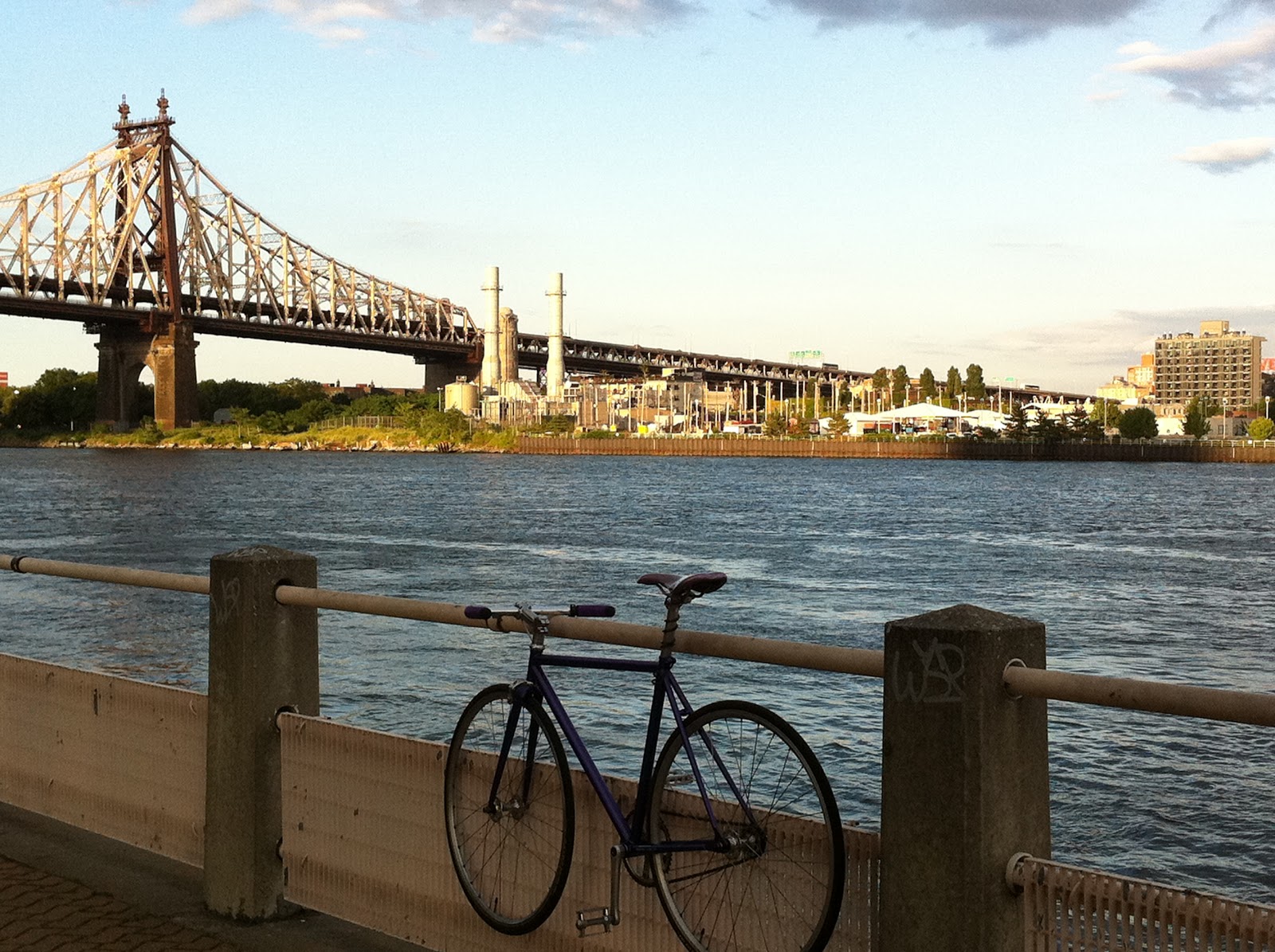
Long Island City, what's your role in all this? July 2011.
with love, 
jp

Friday, March 11, 2011

Brooklyn Community Board 6 collects voices on much debated bike lanes

Last night, round about 400 people muddled through steady rain to reach John Jay High School Auditorium and register their support for or argue against the redesigned Prospect Park West.  Soooooo much has already been said about this project and now the lawsuit filed against the DOT for insufficient community engagement, project monitoring, and data falsification in its process.  And it's touched off debate about the role of bicycles on streets more generally.  The NYTimes, New Yorker (and also), NY Daily News, and New York Observer have all run pieces that play up the street reallocative scandal here.
 (photo of pedal demonstration supporting challenged PPW bike lanes, Oct 2010)

Most portray a wild-eyed, unstoppable and unreasonable Transportation Commissioner who's got ludicrous ideas about what street space is for in this town.  And her defenders have also come to the rescue; the letters written to the Times after last Sunday's truly stilted portrayal by Michael Grynbaum.  But some articles--including the above-referenced Observer piece and of course the Streetsblog's reliable coverage, plus this piece by Aaron Naparstek, and also the Guardian's bike blog piece that ran this week--are speculating on the underlying tension in this vociferous "culture war"--and what's at stake for anyone who doesn't live here.  In some way or another, these latter articles agree that the vitriol invoked by the multiplying, slow-moving obstructions in our streets reveal a clash over future city visions for New York.  
I agree.

Unless we open a conversation about what street apparitions impede our forward thought about paving a next, stay-able place, lots of senior citizens will die thinking that the car was their generation's savior.  Instead, I'd like to see these seniors coaxed back out of doors--especially car doors--and let themselves imagine that their slowing pace of life is actually en vogue, a growing trend among bike and ped commuters.

"How can we humane street lovers help these neighbors find the courage and hope to tune their ears to the word on the street?"
--I found myself thinking last night while approximately 10 elderly people from the lawsuit-filing coalition Neighbors for Better Bike Lanes + Seniors for Safety suggested that cyclist proliferation is more dangerous than speeding cars, and that a high speed, car-crowded street was easier to cross, look at, and fall asleep to at night.  

Heck! even these mean streets' signs aren't shouting anymore!

Should I get a tandem or my very own passenger cargo bike and offer free rides to these folks?  A cyclist-eye view of PPW and many other City streets could help them see that this _is their moment_--the moment when the earlier anti-car battles for slow spaces, lost by their parents are being re-opened.  How could they forget what it was like when the streets were their playground?  
Or have I got my generations mixed up?   
Anyhow, whether they want them for stoopball or pinochle, I'd love to get my fearful, aging neighbors out into their quieting streets and using their twilight years to bring about a more humane City.  

Anyhow, I slapped together a little meditation along these lines--something of a paean to NYCDOT --and tried to deliver it at last night's hearing. 
Sadly, I was a little late in the queue for the invocation, and too early for the benediction, so i've got this mostly unheard sermon I thought I'd post up... 


Community Board 6 Public Hearing
Remarks to the Transportation Committee
10 March 2011
First, I want to thank Councilman Lander and the CB6 transportation committee for your leadership on the issue of what streets we need in this community.  Your diligent monitoring and public relations efforts speak volumes about your concern for the well-being of all who travel or live along PPW. 
And thank you DOT for your patience with us: we realize your job is to move along and improve safety and mobility all over the city, and we’re holding you and our neighboring boroughs’ mobility needs captive.  

But I also want to thank you because, as trained planners and engineers, you know what generations of favoring cars have wrought in this City and your vision for a hopeful future is what has you working so hard for us. 

First, there was the hollowing of the city by car owners who chose distance and single family homes over our City’s advantages. 
And as they went, so too did many of these advantages.

These same commuters’ daily tidal flows to and from our City bound its perimeters like a noose, and tore in half communities like the South Bronx and Sunset Park, Brooklyn.
And soon people-vacated streets made us want to move through them as quickly as possible, in sealed steel and glass.  And while we hid from those streets, crime increased.  So did traffic crashes and rates of serious injury and fatality in them.

More people left and a drag on property values jeopardized the City’s ability to provide for quality services for those who chose to remain.

And of course the outer boroughs took the hit in the most lasting way, and to this day have the longest commutes and most spread out lifestyles, least accessible public transport and… highest car ownership rates.  Many saw the car as their only vehicle for upward mobility--a tragic irony since it is the single most expensive and least efficient form of transport.

Whether filling the streets during the day or overnighting curbside, more cars also brought incredible volumes of CO2 particulate and exacerbated industrial pollutants, yielding shocking rates of asthma and other respiratory illness, particularly in poor communities situated next to highways.

So, thank you, NYCDOT, thank you Commissioner Sadik-Khan, and thank you Mayor Bloomberg for your bold leadership on our streets.  Your foresight to lay down new pathways for the 1 million residents we will welcome in the coming couple of decades is saving us.  You are protecting our future from a repeat fate.
We ask for your patience while we get over these fear-filled memories of a time when cars were our local safety and getaway vehicles.

Be assured that under your leadership, we’re learning to look at our streets and ask them to become as good for people to stay in as they are to move through. 
We’re learning to expect our streets
to make us healthier, to bring us together,
to take better care of our children and seniors,
to enhance our valuable parks,
and feed vibrant, local businesses that don’t depend on car traffic. 

By laying down pedestrian plazas in intersections once a tangled morass, you’re showing us how much we wanted to sit around together and steal a little sunshine in between morning and afternoon work shifts. 

And by installing thoughtfully-designed, separate cycle tracks and bikeways such as the stunning addition up yonder rimming our park, you’re
Saving lives,
relieving our strained and cash-strapped transit system,
drawing us out of doors, out of cars and into our skin,
making it safe for parents and their kids to commute by bike together.

Together, these interventions are doing more than anything to preserve New York’s qualities worth staying for because: 
what happens in these streets doesn’t stay in these streets.

All these improvements spread through our City circulatory system as nutrients to sustain healthier destinations—residential and commercial.  And this is why the US government has always upheld the status of streets as a commons—to protect their anchorless benefits that do not just accrue to the places they run through.  They, too, ought to be put to their highest and best use.

Devoting precious public space to private car parking and speedy throughput is a city-stultifying proposition. 

The privilege of living in New York has to do with its smallness, and all the resources we can access very locally—on foot and on bicycle and transit. 
The more we do this, the more of that kind of close, convenient, familiar New York we invite.  And this is a New York worth staying in.

Cars are for leaving, and if we return them to street pole position, our growing city will go with them.

Tuesday, December 28, 2010

Snow-Blanketing Day: this year's Boxing Day

 (Corner of 7th Ave and 17th St., 1:45pm 12/28)
I missed last wallopping winter in New York, and so was delighted to learn of Sunday's forecast:
Biiiiiiig Snow.
Since soon-to-be-snowy mornings are excellent for sleeping, my housemate's cat Jacques and I celebrated with my down comforter for a respectable stretch of morning.  But when I finally emerged onto Court Street at around 10, I remembered why these are such sleepy mornings.  I walked to my favorite local coffee spot and was lucky enough to nab a corner spot from which to watch the neighborhood's preparations.  I padded the following haikus into evernote on my iphone:


She began slowly
Blown gentle south down Court Street
Trader Joes is packed

Not everysunday;
Post-holiday and bracing
Groggy street awakes

Sidewalks get salted
Truckful waits at Atlantic
How much for a pound?

Strollers staying home
Cafe Pedlar's windowseat
Is mine for hours

Big plow pacing Court
Anticipates hero's call
Helpless New Yorkers

What began gently
Brings force of 18 inches
(is what they're saying)

Show us, white witness
What altitude really holds
We'll cover our heads

****

Anticipating Snowpocalypse 2010: The Final Saga, the YMCA around the corner closed early that afternoon, so I went for a merciless pelting ('run') south from downtown Brooklyn, instead of hitting the pool.  I looped south to the terminus of Columbia Street at an NYPD evidence vehicle yard in Erie Basin, then west/northwest along all the most deserted streets of Red Hook, back to Pier 6 and along the waterfront north through Brooklyn Bridge Park, up Old Fulton a block and then back up to the Brooklyn Promenade and home via Joralemon (pronounced with puckered lips: 'you're a lemon').  I wore rainpants and a water resistant running jacket, but the most essential pieces of attire were my wool baseball cap and glasses.  Face thoroughly blasted and stinging I made it home while there was still less than 9 inches on the ground and the wind hovered at a respectable but bearable 20-25mph.

Indoors, warm, dry, and fed but with no promise of escape predicted until the next night, by 8pm I was filling in my Facebook status bar:
"...out of shape for this snowbinding weather sentence."
Both housemates were away for the holiday week and though earlier relishing the solitude, I was soon saddened by a weather event weathered alone.
"Jacques," as I later wrote to a friend, "is bad at board games."

The 'mates and I had spent the smallest hours of Tuesday night the previous week up on our windy 4th floor tenement-top watching the lunar eclipse.  And in a memorable display of our sibling sensibility, Ryan and I spent the better part of the hour and a quarter patiently (and in multi-media) explaining to Nathalie just how a lunar eclipse works.  And then she pulled out some obscure brilliance about differently refracted light and the color spectrum when one of us mentioned the moon's earth-shadowed redness.  We froze our asses off and howled at the moon (my idea), and made up stories about the residents of the fancy condo towers that made it clearer than ever why our little building (smallest, oldest, shabbiest on the block) was such a slum.

I sent them both multiple musings from my side of the storm, and eventually went to bed, wind's howl threatening to slice right through the painstakingly-plasticked window holding our livingroom AC.

The NYT ran this hilarious piece that captures how this particularly whimsical snowpocalypse [almost San Franciscan in its block-by-block varied effects] humbled our unstoppable city.  And though everyone is pissed at Bloomberg, blaming him for slow-responding plows, people I saw today and yesterday seemed pretty tickled to be walking up the middle of usually car-jammed Court Street.  And the narrowly-shoveled sidewalks require the patience of a group hike, while I've seen strangers offering each other's arms across particularly boggy intersections.  On 17th Street in Manhattan this afternoon (wish I'd snapped a photo!!!), I watched two boys (or at least one boy and another set of boy-looking legs) building a top-access tunnel in a (no joke!) 5 foot-high snowbank.  The adventure is fun for the able-bodied among us.

Still, reports of people injured and unable to be reached by emergency vehicles are also stacking up, giving off the impression that some neighborhoods are more strategic than others.  Even City Council Speaker Christine Quinn, normally a Bloomberg ally, decried the City's slow response and is calling for a Council hearing to investigate dynamics behind slow excavation.  But even near 121st and Broadway yesterday afternoon, I'd come upon an elderly woman hesitating to step onto a slick-looking mound of sidewalk slush in her path.  I did like we always do, and gratefully lent her some support, talked her over the hurdle.  It's possible that many more like her haven't even made it out the house yet.  If my roommates were here to show me how to turn on the TV [again], I'd hope to see NY1 reminding its able-bodied, still home-bound watchers to check in on their less mobile neighbors. 

A weather event like this can quickly transform from an opportunity to be blessedly vulnerable and playful together in our altered streets.  It becomes a tragedy when response to basic needs in its midst are stymied.  And though we pay taxes for snowplows and snow removal (sort of), it is we, our beloved cities' neighbors, who are the most informed first responders.  Can we really expect city agencies to care better for our blocks and buildings--and most importantly their least visible residents--than we do?

One recommendation I'd make to the City Council at its blizzard hearing is for formation of an emergency first responding block captains corps.  Surely informal versions of this has existed at less 'automated' periods in NYC history?  Emergency Block [or Building, depending on block FAR] Captains (EBCs), could consult an electronic inventory of local volunteers, sorted by nature of disaster, and locate ones equipped with skis, brandy, first aid training, flexible work hours, etc., and assemble the appropriate crew for a given emergency.  These would fan out over a block surveying the state of each household's needs, and in turn contact secondary responders ready to cook, deliver babies, emergency medicine, etc...until City services were again functional.

What good is a Cityful of the world's brightest if we don't pool our brainpower when it matters most?

Fissures, breakdowns, disconnects are inevitable when the scale of provision is a city as striated as this one.  Though the ideal scenario is always universal, indiscriminate access, various structural obstacles prevent this even flow.  Still, New Yorkers can do a lot to fix our place in the small places we care about.

Stay tuned for: brownsnow rivers in streets: crossing guards to the rescue

Friday, December 17, 2010

how does memory make a place? how can being in a place re-place its memory?

i love staying in certain places for lots of reasons:

what their smells reminds me of;
the refuge they can offer from more difficult places;
what they teach me;
so i can bring them to people i love, and when i'm lucky, vice versa.


 the above is an email I sent to my ex-husband the other day.  We haven't shared the same place since 2005, but the last 'scape we co-navigated was New York City's, when we were both adjusting to emigrant status.  Los Angeles transplants, we made sense of winter and odd phenomena like close proximity (propinquity, i later learned in my fancy pants grad school classes) in our own westerly ways, through lenses set on our noses by a very differently-mapped place.  we had ways of referring to the miserable, all-weather-under-equipped chinese food bike delivery guy in our neighborhood--the epitome of human suffering--and coined various other quips to help us stay on top of New York's streets. 

My first winter without Ron was miserable.  So, too, my 2nd, 3rd, 4th, and 5th, after which i scurried home for a year's respite in Los Angeles.  Those winters I fared by bike alone, without day's end swapped stories about frozen knees and snot and the revelation of a new strategic layering technique (one that kept you warm but not sweaty, even in the armpits), or charming NYPD out of giving me a ticket for running a red light. 
But I wished the whole way that I was better accompanied. 
Memory of that earlier, shared place kept me from delighting in the now place that--asphalt be praised!--I was making my own without even knowing it, crossing a new East River bridge than that which we'd shared.  Still, every third pedal stroke stirred the Ron-sized-void in me.  I didn't learn how deeply the 'asphalt be praised' had run into me until I left, returned to sunnier climes.  I missed it the whole time.

It's my first winter back in New York City, and I am loving every blast of wind's whimsy, and frigid bike ride into and out of Manhattan.  I've learned what body parts must be warm and how to protect them, and which can weather some cold.  I've learned that the usually W/NWerly wind this time of year resists me in the morning, and urges me back home in the evening.  And that the air temp can even be warmer at night!  And more than that, I recognize other year-round commuters, or people that reliably fill the places I pass, and they too are my personal place-markers.

But now that I live in downtown Brooklyn, my commute isn't long enough so I usually meander the crooked north Brooklyn coast, crossing the Williamsburg Bridge and reveling in the Midtown Manhattan view north along the bi-directional bikeway along Kent Ave. through Williamsburg, to Franklin Ave. in Greenpoint, to Newtown Creek, and then back, hugging the waterfront as warmly as I feel embraced by her.  I wasn't ever before open to being place- (and cold-) permeated like this.

I wrote to Ron (who never responds) the other day out of delight instead of longing for companionship.  During my 2 am ride home the night before, I'd laughed aloud about the seasonal phenomenon of sidewalks sprouting douglas firs tended by Montreal and East European urban foresters we've got here in New York--an image I'd never shared with anyone, and didn't need to.
 
Five years after, I am making my own place, and we love each other.

Friday, December 10, 2010

Who wants streets for a New York City worth leaving?

New York City streets are finally worth staying in, but some residents they benefit most, want to leave. 
     In a City best accessed by shared transit and foot, bikes have lately commanded more attention because their movement is finally patterned into more pavement.  And since NYCDOT began to roll out an ambitious array of new bike and ped facilities in 2007, bicycling has dramatically increased.  It took a beat, but motorists are beginning to notice that their own far and fast style of movement has accordingly been curbed, and they are not happy.  And instead of seeing the many ways peopled streets will make them richer in a place valued for staying, these motorists are insistent upon the return of streets better for leaving.  


On Thursday December 9, the City Council's transportation committee held a standing room-only public hearing on bicycling.  In its coverage, the NY Times cast the hearing as a battlefront, capturing the truculence prevailing in streets where cars and people are pit against each other.
Cyclists turned out in droves--many were turned away when the small hearing room reached capacity.  They testified at length to the health, economic, environmental, and civic good of bicycling prompted by these better facilities.  The naysayers were vocal and vehement--implying or directly insisting that more space for human-paced movement violated their "rights" as motorists.  Former Mayor Dinkins' Deputy Mayor Norman Steisel is the opposition's public face, and used his status to jump the speaker line and extend his 2-minute slot to 16.

Steisel has been on a months'-long mission to convince his neighbors directly-adjacent to Park Slope's Prospect Park West--where a bi-directional bike lane and median-style parking lane have improved park access for bicyclists, slowed traffic and diminished the crash rate--that these lanes are underused and un-necessary.  He even claims they are blighting the surrounding neighborhood.  Steisel even teamed up recently with another Park Slope resident, former DOT Commissioner Iris Weinshall, and met with bikes-supportive Park Slope City Councilman Brad Lander, to express their disapproval of the lane on PPW.  One source close to Weinshall reports that she's upset because unloading groceries from her car feels more difficult than it used to.  Rumors are circulating that her husband, U.S. Senator Charles Schumer, has also entered the fray and may be involved in behind-the-scenes efforts to choke the lane's future and return PPW to its speedway status.


For his part, long-time Park Slope resident and Brooklyn Borough President Marty Markowitz,  sang a mocking ode to the bike lanes of his borough, likening them to various seasonal, ephemeral flavors--like eggnog.  Only in Brooklyn.

Oddly, Steisel, Weinshall and Markowitz  (let's call them the Park Slope Car Crusaders or PSCC) fail to recognize their self interest in defending bike lanes rolled out on the asphalt adjacent to their properties.  Many studies have demonstrated the positive impact of dedicated bike lanes and paths on two things homeowners care about most: declining crime rates and rising property values.  In a neighborhood where real estate is spectator sport, ignorance of this compelling fact by such long-time homeowner/insiders is shocking. 

But I suspect the PSCC is mistakenly conflating the benefits of homeownership with those of car ownership, a correlation which just doesn't work for Park Slope.  In communities whose value is largely traceable to the single family home, car ownership is essential to creating and sustaining the value of all surrounding land uses.  Commercial land uses from retail to industrial developments require the labor and money inputs of single family homes in order to produce their goods and services which can in turn only be profitably exported by personal automobiles in high volume.  But Park Slope and most of the developed land in all five boroughs do not derive their value from the single family home.  Instead, they are valuable because of the density of social resources and economic activity supportable in this small city on top of the world.  Most people do not go to work or for regular shopping trips in personal automobiles--we ride the subway and buses, occasionally take taxis, walk, and increasingly, we ride our bicycles.  We do this because the distances we navigate are not vast, and the places they contain are rich with the resources we seek.  And yet, for the better part of the last century, we planned our streets in a way that gave car movement the right-of-way, as if its circulation was a better value import-export mechanism than these other modes.


For generations, the abundance of free, on-street parking, signal timing, and lane apportionment sent the message that personal mobility in cars was somehow key to unlocking the City's highest and best use.  And while this may have been an almost reasonable conclusion at the height of US suburban expansion or in the depths of the City's fiscal crisis, it could have only resulted from intense dependency on public subsidies for everything from fuel to air pollution, public health costs to central city property's devaluation.  We now know that what we imagined were 'investments' actually cost us our place.  As such, we can no longer demonstrate that everyday use of personal automobiles in New York City retains any meaningful role in its economic growth or the quality of life required to sustain it.  While the City has at other times been worth leaving, its current global economic primacy results from its qualities worth staying for.  Density is primary among these in a knowledge-based economy like ours has become, and creates economies of scale that only reinforce this strength.

At an earlier moment in New York's development, density was a breeding ground for cholera, and as its population exploded during the City's rapid industrialization, lack of open spaces and pollution were serious.  Private automobile ownership's increase in the City, particularly through the 1920s, was welcomed by many urban planners and downtown business owners as a savior.  Especially once the first urban highways were built, the personal automobile was expected to relieve congestion that harmed downtown business.  But few anticipated how compromising the car's gradual dominance would be to the City's basic qualities of place.  Its central business district remained choked with the cars of suburban commuters eager to leave at day's end.  Its elevated highways sliced neighborhoods in half and created dead, shadow zones underneath them.  Instead of being saved by the automobile, its ownership created blight.

But today things are different.  We aren't any longer an industrial manufacturing city.  Instead, we anchor clean industries--education, arts, finance, professional services--all of which like a nice place to stay.  More bike lanes and pedestrian plazas are part of the Bloomberg administration's attempt to protect the City's place-based strength, and retain these propinquity-dependent industries.  In this way, bike lanes, waterfront parks and pedestrian plazas are direct social investments in the City's economic health.  Air and noise pollution and congestion decline with decreased automobile use, and generally make better use of the City's most productive raw material: its land.  Together, these new street uses offer more reasons to make daily trips in our bodies instead of our cars, and in the process we offer ourselves an important form of health insurance by reducing our weight and risk of diabetes.


Cars are for going.  Bicycling, walking, skating, rollerblading, scooting, skipping, cartwheeling are all modes of staying.  Their increase among people of all ages in our streets is a phenomenal sign that we are a place worth staying in, which is worth congratulating.

The current DOT's efforts to reapportion streetspace for human needs is confusing for motorists to understand because it changes the message they have long read in the asphalt from:
"we can't live without you!"
to
"wait your turn." 
And people like the PSCC are just not accustomed to being told to wait. 


Maybe they could find a way to hear this new pavement, unbuffered by their windshields.  The asphalt, afterall, is speaking a different language, and they might feel less attacked if they learned it.  The PSCC polyglot could mount a bicycle (equipped with a handsome basket for groceries), wave at a neighbor, notice a kid's two-wheeled delight, and instead of "wait your turn," they might hear:
"Stay!!"

But if "free" parking and access to leaving--even if slowly--on a personal whim are more important to the PSCC than health, safety, and economic growth--let alone _sheer delight_, then perhaps they ought to relocate to places better for leaving.  Many localities still readily absorb the high costs to public life and place imposed by free parking and speed, along with congestion that accompany high rates of automobile ownership.  My hunch is, however, even the placeless places that have survived under conditions of automobile dependency, if they mean to endure in a post-industrial US, will be busy planning streets for people instead of cars.