thoughts and images about how to stay in place...

be where it's hard, take note(s) where it's easy, delight in smallness, let yourself be transformed.

Sunday, September 11, 2011

Paint yourself city

National Geographic's kids magazine World (rip) had this awesome feature on its back cover, where readers were asked to match odd, up-close images to their source. I honestly don't remember anything else about the magazine, but puzzled over these photos every month.

So I've loved features like this, where Daily News readers were asked to match a tattoo to the face of its host:


At one point, I mused extensively on the idea of keeping a bodily record of my cities. The idea was, I wouldn't lose the life lessons I'd been taught if I could write their sites on my skin. A tradition older than Proverbs 3:3, whose
Do not let kindness and truth leave you; Bind them around your neck, Write them on the tablet of your heart
...has only ever appeared to me as tangible as real people in real places offering themselves as gateways to kindness and truth, even if through suffering.

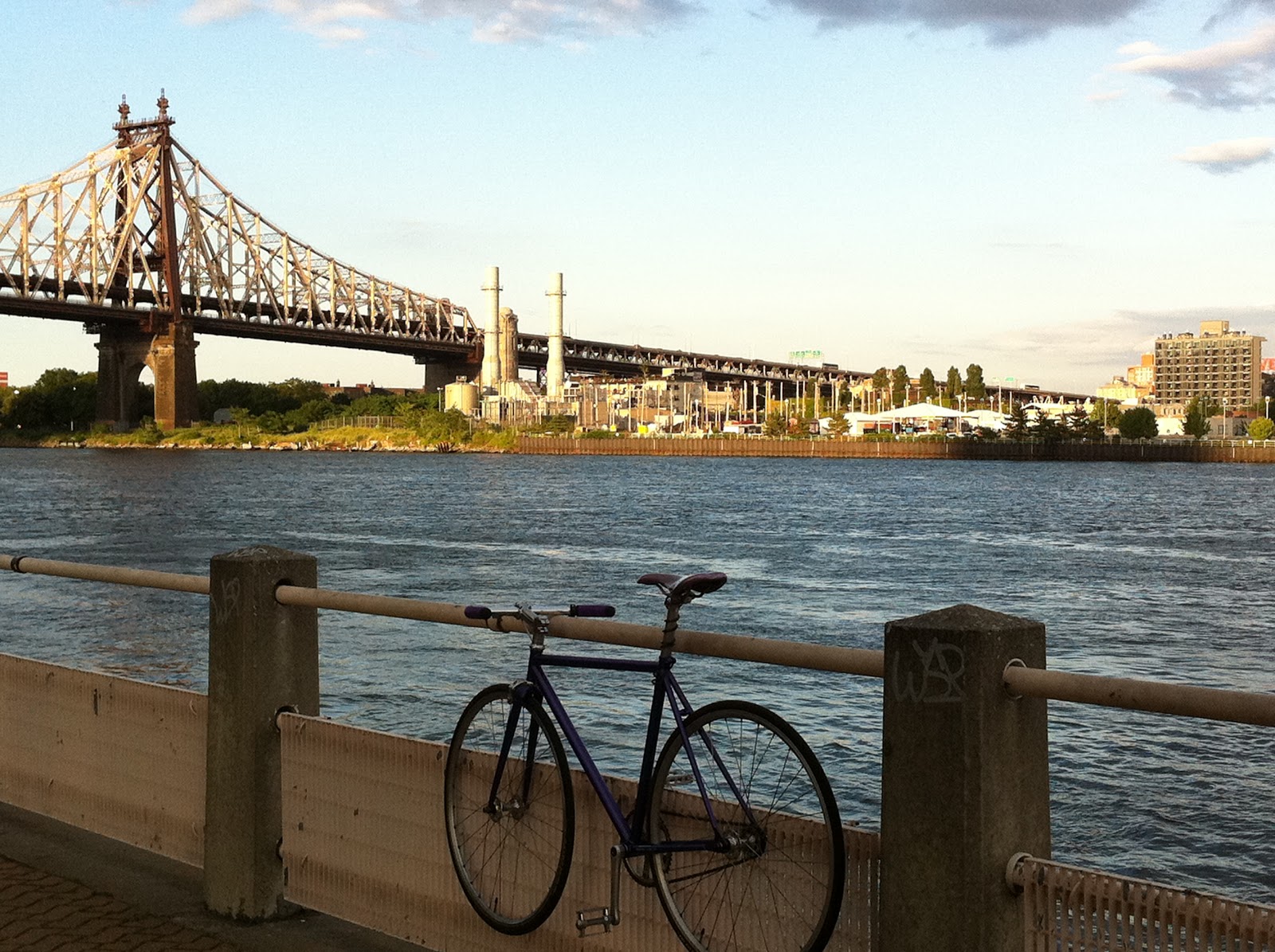
For me, places are about 70% emotional aftertaste of hard lessons learned. Only 30% is the place of This Moment, whatever external and internal conditions frame a given day's ways of seeing. I'm working on it, but even today I can't bike over the Williamsburg Bridge without the pedals spinning me back to harsh winters where this was my bridge between haunted home and harrowing day. Of course it was true year-round during that phase of struggle, but the messenger bag never felt heavier than when I pedaled into the biting eastbound wind during fierce cold mornings. And so it was that I thought the shape of her industrial majesty would be an appropriate topic for the long flat of my back.

 (Source: Daily News)

But one immediate obstacle was that the striking visual of perpetually changing "bridge art," let's call it, would go missing from the tattoo. In fact, the whimsical to angry displays other artists exhibited there also made my map. Because I wasn't alone on a merely technical conveyor between points A and B, the art of others was an invitation to just keep going, if only to see what got painted or pasted overnight on this or that stanchion up ahead. And the performance artists, too, most especially the orthodox ladies with their matching dresses, wigs, strollers, were part of my picture. My skin is thick and pliable, but it definitely couldn't contain all of this. Even if I could get some of these elements in a design, it would still be too one-dimensional, a graven image rendered by the hand of a single artist instead of the hands and feet and voices of the many who'd qualified it so singularly.
(Williamsburg Bridge upper deck--the only view I'd ever had! Source: JacobDaJew)

(Among the most prestigious revolving canvasses. Source: Google Images)
(Street Artist Judith Supine's "Above the City in a Summer Night Dream." Source: Gradient Magazine)
But honestly, and all poetry in motion aside, the more practical impediment was the canvas itself--my skin's own system of lines and cracks for record-keeping. Painting over it might just betray all the wisdom I intended to represent with the tattoo. And so unless I could work up a design that would grow (shrink? sag? dry and crack?) with me--which could actually work with a bridge tattoo, come to think of it--the surface of all this place-keeping would undermine my artistic intent with its own. So I scrapped the tattoo idea and yielded to my inner artist, trusting she'll speak of the depths and heights in skin and other media as dynamic as the places that summon her.

Sunday, August 7, 2011

Love Letter

Dear New York,

Have you had your way with me? I've been straining to hear from you on this, tuning my ear to the word on the street, your sirens' songs, but I can't quite get it. Does your serendipity I so reluctantly learned still hold lessons, and most important the possibility it has before? I feel like i've finally gotten good at being alone with you, trusted you to break my heart and hold me together, which was a hard one. So if it is over for now I'd be surprised, really, since I do think we've finally learned to communicate. 

 Through chainlink, darkly. Greenpoint Brooklyn, Nov 2010.

What's more, i still haven't figured out how to reciprocate. You know how much I've learned from watching you, trying to keep up with those who've run with you longer. You finally convinced me that my own speed and vantage are valuable and so I'd like to see you really get something from them--you know this means a lot to me. it's the full circle of lessons. but maybe my eyes aren't well enough adjusted for that, either? or maybe trust is the lesson.

Though I try and keep him a separate consideration, what's hard is your cousin in the far west is so clear and insistent about his position on this question. He reminds me with simpler problems and people, but also the unmistakable voices of loved ones. I remember my last long stay with him, thinking as I pedaled along his jacaranda-carpeted shoulders in late spring that i felt like an exotic bird there in that asphalt jungle. It was a nice feeling to be rare and precious, but I yearned for you most of the time.
Not jacaranda but some other fallen blossoms. Disney Concert Hall, Los Angeles, January 2008.

Aside from the reciprocity snag, I also don't even think we've really spent a whole weekend just relaxing together. And you have such nice places to relax! Does it mean we work well together but we can't play? I mean, I've always chocked that up to circumstance, but maybe i'm deluding myself like so many others who claim "too busy!" to do normal things like hang out. Oddly, I don't seem to have that problem with your cousin of the west.

Anyhow, I really do hope you can show me some recognizable sign soon, because I feel my deep affection for your waterfront tugging at me to do something for its equitable access, to cast a Vision 2020 wide enough to reel in people as far inland as East New York, Bronxdale, Glendale. What's more, your sectors are a lot more fluid than in other places and that is quite possibly the most attractive, irresistible thing about you; I want the challenge posed by constant translation. i want to take your real estate and make it really estates, show property values how to grow nearer to property's values. And I want to stumble sometimes and kick ass other times, but most of all show you what you've taught me. Give back a little. Learn more in another chapter or 2 or 3 lived.
The High Line. Manhattan, NYC October 2009)

 So, let me hear from you, okay? And soon. I'll wait awhile longer but I can only read so much Rilke. And though his wisdom helps with the yearning, it doesn't pay student loans. But you know, it's also okay if now isn't the time; we know ours is a long-term thing with seasons of near and far togetherness. I could get used to the idea, probably.

You know where to find me, my insatiable, formidable companion.

Long Island City, what's your role in all this? July 2011.
with love, 
jp

Friday, March 11, 2011

Brooklyn Community Board 6 collects voices on much debated bike lanes

Last night, round about 400 people muddled through steady rain to reach John Jay High School Auditorium and register their support for or argue against the redesigned Prospect Park West.  Soooooo much has already been said about this project and now the lawsuit filed against the DOT for insufficient community engagement, project monitoring, and data falsification in its process.  And it's touched off debate about the role of bicycles on streets more generally.  The NYTimes, New Yorker (and also), NY Daily News, and New York Observer have all run pieces that play up the street reallocative scandal here.
 (photo of pedal demonstration supporting challenged PPW bike lanes, Oct 2010)

Most portray a wild-eyed, unstoppable and unreasonable Transportation Commissioner who's got ludicrous ideas about what street space is for in this town.  And her defenders have also come to the rescue; the letters written to the Times after last Sunday's truly stilted portrayal by Michael Grynbaum.  But some articles--including the above-referenced Observer piece and of course the Streetsblog's reliable coverage, plus this piece by Aaron Naparstek, and also the Guardian's bike blog piece that ran this week--are speculating on the underlying tension in this vociferous "culture war"--and what's at stake for anyone who doesn't live here.  In some way or another, these latter articles agree that the vitriol invoked by the multiplying, slow-moving obstructions in our streets reveal a clash over future city visions for New York.  
I agree.

Unless we open a conversation about what street apparitions impede our forward thought about paving a next, stay-able place, lots of senior citizens will die thinking that the car was their generation's savior.  Instead, I'd like to see these seniors coaxed back out of doors--especially car doors--and let themselves imagine that their slowing pace of life is actually en vogue, a growing trend among bike and ped commuters.

"How can we humane street lovers help these neighbors find the courage and hope to tune their ears to the word on the street?"
--I found myself thinking last night while approximately 10 elderly people from the lawsuit-filing coalition Neighbors for Better Bike Lanes + Seniors for Safety suggested that cyclist proliferation is more dangerous than speeding cars, and that a high speed, car-crowded street was easier to cross, look at, and fall asleep to at night.  

Heck! even these mean streets' signs aren't shouting anymore!

Should I get a tandem or my very own passenger cargo bike and offer free rides to these folks?  A cyclist-eye view of PPW and many other City streets could help them see that this _is their moment_--the moment when the earlier anti-car battles for slow spaces, lost by their parents are being re-opened.  How could they forget what it was like when the streets were their playground?  
Or have I got my generations mixed up?   
Anyhow, whether they want them for stoopball or pinochle, I'd love to get my fearful, aging neighbors out into their quieting streets and using their twilight years to bring about a more humane City.  

Anyhow, I slapped together a little meditation along these lines--something of a paean to NYCDOT --and tried to deliver it at last night's hearing. 
Sadly, I was a little late in the queue for the invocation, and too early for the benediction, so i've got this mostly unheard sermon I thought I'd post up... 


Community Board 6 Public Hearing
Remarks to the Transportation Committee
10 March 2011
First, I want to thank Councilman Lander and the CB6 transportation committee for your leadership on the issue of what streets we need in this community.  Your diligent monitoring and public relations efforts speak volumes about your concern for the well-being of all who travel or live along PPW. 
And thank you DOT for your patience with us: we realize your job is to move along and improve safety and mobility all over the city, and we’re holding you and our neighboring boroughs’ mobility needs captive.  

But I also want to thank you because, as trained planners and engineers, you know what generations of favoring cars have wrought in this City and your vision for a hopeful future is what has you working so hard for us. 

First, there was the hollowing of the city by car owners who chose distance and single family homes over our City’s advantages. 
And as they went, so too did many of these advantages.

These same commuters’ daily tidal flows to and from our City bound its perimeters like a noose, and tore in half communities like the South Bronx and Sunset Park, Brooklyn.
And soon people-vacated streets made us want to move through them as quickly as possible, in sealed steel and glass.  And while we hid from those streets, crime increased.  So did traffic crashes and rates of serious injury and fatality in them.

More people left and a drag on property values jeopardized the City’s ability to provide for quality services for those who chose to remain.

And of course the outer boroughs took the hit in the most lasting way, and to this day have the longest commutes and most spread out lifestyles, least accessible public transport and… highest car ownership rates.  Many saw the car as their only vehicle for upward mobility--a tragic irony since it is the single most expensive and least efficient form of transport.

Whether filling the streets during the day or overnighting curbside, more cars also brought incredible volumes of CO2 particulate and exacerbated industrial pollutants, yielding shocking rates of asthma and other respiratory illness, particularly in poor communities situated next to highways.

So, thank you, NYCDOT, thank you Commissioner Sadik-Khan, and thank you Mayor Bloomberg for your bold leadership on our streets.  Your foresight to lay down new pathways for the 1 million residents we will welcome in the coming couple of decades is saving us.  You are protecting our future from a repeat fate.
We ask for your patience while we get over these fear-filled memories of a time when cars were our local safety and getaway vehicles.

Be assured that under your leadership, we’re learning to look at our streets and ask them to become as good for people to stay in as they are to move through. 
We’re learning to expect our streets
to make us healthier, to bring us together,
to take better care of our children and seniors,
to enhance our valuable parks,
and feed vibrant, local businesses that don’t depend on car traffic. 

By laying down pedestrian plazas in intersections once a tangled morass, you’re showing us how much we wanted to sit around together and steal a little sunshine in between morning and afternoon work shifts. 

And by installing thoughtfully-designed, separate cycle tracks and bikeways such as the stunning addition up yonder rimming our park, you’re
Saving lives,
relieving our strained and cash-strapped transit system,
drawing us out of doors, out of cars and into our skin,
making it safe for parents and their kids to commute by bike together.

Together, these interventions are doing more than anything to preserve New York’s qualities worth staying for because: 
what happens in these streets doesn’t stay in these streets.

All these improvements spread through our City circulatory system as nutrients to sustain healthier destinations—residential and commercial.  And this is why the US government has always upheld the status of streets as a commons—to protect their anchorless benefits that do not just accrue to the places they run through.  They, too, ought to be put to their highest and best use.

Devoting precious public space to private car parking and speedy throughput is a city-stultifying proposition. 

The privilege of living in New York has to do with its smallness, and all the resources we can access very locally—on foot and on bicycle and transit. 
The more we do this, the more of that kind of close, convenient, familiar New York we invite.  And this is a New York worth staying in.

Cars are for leaving, and if we return them to street pole position, our growing city will go with them.

Friday, March 4, 2011

Fun with Trash

This winter's huge snow storms left big white snow banks crowding NYC streets' shoulders, but also black trash mountains.  And recycling: bundles of cardboard and large, clear bags of plastic and glass, plus miscellaneous bulky items.  Sanitation workers occupied with removal of the great white visitor that threatened us all, the city's daily detritus (plus the usual complement of TVs, clothes, furniture...) would stack up for days--two weeks went by before curbside pick-up resumed after the first big blizzard hit on December 26.

 (kids playing at the base of a massive snow sidewalkgnome built on the northwest corner of Canal and East Broadway, Jan 29, 2011. Note orange cone top hat, courtesy of NYCDOT)

After snow heaps receded and trash remained, I thought about rounding up some friends to join me at creating a multi-cited sculptural commentary on the situation: I envisioned  3-black-bag-tall 'trash men' complete with bottle cap eyes and aluminum can pull-tab noses springing up in strategic locations (the steps of City Hall?  The Sanitation Dept. headquarters' curb?).  Instead, I wrote these haikus, while the streets and sidewalks still bore witness to that storm's social crisis:

I love a Saturday
When new years eve is Friday
Streets recovering

White wet receding
Replaced by mountains of trash
Busy bulldozers

Hurried, heroic
Racing high temperatures
But not quick enough

Third term sullying
Blizzard buries Mayor Bloomberg
As if by design

Black trash bags
Splintered pallets broken crates
Chinatown wreckage

January and early February brought more storms and more heaps of trash, but the visuals weren't ever quite as striking as that first storm.  In the end, it's been a rather trashing winter--New Yorkers have been with fairly frequent reminders of their voracious consumption.  Aggregated in biggening curb walls, our trash froze and thawed, grew white afros and then shed them, got stray, cast-off bits tossed onto them, and waited around for their ticket onto a truck and eventually up or downriver on a barge.  They embarrassed us with their persistence, and annoyed us when we were in a hurry and had to single file past them on our sidewalks.  Luckily, it was too cold for rats and roaches.  I know I wasn't alone in thinking it could be good for us to live semi-regularly with these betrayals of our appetites for take-out and single-serving yogurt.  Wonder whether we could come up with the curbside pick-up equivalent of this special Swedish can, brought to us by Volkswagon, via Andrew Revkin's NYT Dot Earth blog:


Thursday, March 3, 2011

Google Streetview Peddler: My new career aspiration

Though I am [gratefully and at last] nearly a doctor now, news about Google's new mobile map-researching trike has me itching for a return to my most purposefully philosophical, car(e)-free grad school days.


For about half of my grad school summers, I maintained a tradition (cultivated the art of...) _the fun summer job_.
(the author during bike work summer, c. 2008)

Hands down, the best best best of them was working the streets for a few months on Birdbath Bakery's cargo bicycle*.  Already a student of the streets, it was this summer as honorary member of NYC's two-wheeling pedal force, that I really reveled in the bike's city-seeing powers.  How bulk and classification as 'delivery vehicle' changed my relationship with motorists and other cyclists were protracted, provocative meditations through my 7 hour shifts.

I'd leave home at 5am and ride Violeta across the Williamsburg Bridge through vulnerable, just waking streets known only to dog-walking early-risers and NYC sanitation workers.  With my back to Brooklyn on that bridge,  I'd watch the sunrise knife a big, red gash into the side of the black glassy UN building, three times per week.  A gesture from the east about US-headquartered world diplomacy?  Could be.

The Revolution Rickshaws depot, founded by Gregg Zukowski, was at that time a couple of alleyway entrance-only "garages" on W. 35th Street near 9th Avenue.  Bike safely locked against a fence back there, I'd pick up Birdbath's rig, and pedal down 9th Ave., wiggling my way gradually to 1st Ave. and 14th Street, where Birdbath's 'home' bakery was located.


(film about Birdbath, starring my boss, restauranteur Maury Rubin. Produced by PlentyTV, c. 2007)

There, as two-three other times in a work day, I'd pick up trays of cookies (that slid into a custom-fitted baker's rack inside the cargo hold), large tubs of iced tea, coffee condiments and various paper goods, and pedal across town to the [now shuttered] other Birdbath, at Charles St. and 7th Ave.
I'd also make runs to The City Bakery on 18th Street (Birdbath's parent), for iced coffee, sandwiches, and *most important* to fuel up--rickshaw drivers could have an all-you-can-eat meal from The City's conscionable buffet-style dining room.

On all of these runs, in sweltering summer heat radiating off the asphalt and in heavy downpours, I was elated to be learning traffic work to complement my habitual traffic play.  Not only had i joined the multi-modal factory floor, cooperating with large UPS trucks, deft and swift bicycle messengers, wrong way-riding-addicted food delivery guys, I'd joined a class of manual laborers where white 30 year-old, advanced degree-seeking women were a rarity.  I pondered gendered division of street labor, but also what it meant to volunteer for NYC's vital but woefully underpaid service class.**  Several encounters delivering City Bakery's green food to catering customers, where I was treated rudely--neither thanked nor tipped for my efforts balancing boxes, bags, coffee dispensers and a helmet while holding open doors for me and the customer--were privileged views into a pitifully common but nevertheless veiled side of what money could buy conscience for lunch.

But mainly  I had visceral fun.  I was in great shape, and once I really got the hang of maneuvering that 200-lb rig, had a blast as a still-human-powered-but-now-with-greater-girth traffic dancer.  That summer also marked NYC's inaugural Summer Streets event, where Lafayette Street and Park Avenue were closed to automobile traffic for a blissful sunday morning of running, walking, cycling, dancing, skipping, scooting, skating, mid-road drawing and more.  And for that, I borrowed a passenger rickshaw and captured what was among my proudest streetworking moments:
(the author with still minor celebrity NYC Dept. of Transportation Commissioner Janette Sadik-Khan)

So, even though I'm about to graduate, I, like so many others, just might go work for awhile 'at' Google...Who knows? maybe they'd pay me to pedal Iceland collecting streetviews this summer...


*Though Birdbath 2 has been closed, Birdbath has three new NYC locations--in SoHo, TriBeCa, and the New Museum's cafe.  Soon, Third Avenue between 9th and 10th Street will also host a Birdbath.

**Unlike the mobile factory floor's other pedal workers, however, I was paid a fair hourly wage rather than a piece rate (i.e. comped by number of deliveries made /papers served, and tips).  The difference is significant--the more common piece rate is a structural explanation of the regularity with which self-propelled street workers violate traffic laws, and have earned a reputation as menaces to pedestrian safety: courtesy is costly to such low wage earners.  This situation is likely to improve in the coming years as a densifying NYC shifts to a more efficient and perhaps even centralized cargo delivery system.  Eventually, UPS and FedEx may replace some of their large trucks and vans with high capacity, human-powered bikes and trikes.  And demand for their speedy and safe operation could even result in human-powered cargo lanes on streets, complete with strategic signal sequencing.  Infrastructure and regulation like this could drastically improve the current ped/pedal worker space competition.

Saturday, January 15, 2011

A good mayor makes you want to stay

In the tireless tradition of "Best [blank blank] in New York", New York Magazine's current issue features a debate between credentialed City wave-getters, about who [in the Modern Era] has been the City's best mayor.  
The feature begins--

The Greatest Mayor: “How Would Dinkins Have Done, Had He Come After Giuliani?”

Being a larger-than-life character helps. But so does keeping the streets plowed.

Fiorello La Guardia at City Hall, October 1945.
In the article, Professor John Mollenkopf, political scientist at the CUNY grad center, Jennifer Cunningham, political consultant and media strategist, Bob Hardt, political director at NY1 (TV), and the Rev. Al Sharpton (whose most descriptive epithet is: Sharpton), each weigh in on Fiorello LaGuardia (the affable), John Lindsay (the lanky, stoic, and work-a-day), Rudy Giuliani (the bombastic), and Mike Bloomberg (the unapologetic private jet owner).  Each bring vague but valuable points from their views on the matter, but there are no statistics, few specifics.  And there neednt be: everyone knows the piece is an offering into city air thick with blame for Bloomberg over slow response to last month's wham-o snowstorm. We want to talk about this now because we're pissed now; who really is/was the City's best mayor isn't really the point. 


And for this, I love the piece like I love all 'Best of...' schtick journalism in New York City.  Here's why:

First, we all identify.  Like in our pizza debates, these articles make us lean in to catch every strand and/or to chime in with a nuance that displays our estoric localism--as if puzzling out the Weightiest Question of Our Time.  
I mean, for the whole world.  
True, New York is a global capital--we are home to some of the wealthiest individuals and powerful decision-makers in the world, and we churn them out reliably, through the ages.  So yes, even a casual reader of NY mag, sitting in a doctor's office in Paducah, KY (that charming south/midwest border city, perched on a gentle bend in the Mississippi, overlooking Illinois) ought to sit up and take notice of these 'best of...' verdicts.  How else would they judge the merits of the new, "Brooklyn-style" [sic] pizza offering on Pizza Hut's menu in the local strip mall?
It is only our ingenuity and refined taste that they can now discern what a brick oven versus a CNG-burning oven can do with bread and cheese!  

Second, I love this genre because we typically feature the opinions of prominent, well-educated or well-worn New Yorkers--those who have gone to school in the arts of staying New York, or even teach school in it, for that matter.  Following the 'best of...' template, this week's 'Best Mayor' is gently moderated, and each contributor chimes in with evocative observations or anecdotal evidence from this or that mayor's career.  And if we can at all locate their references, we eagerly join in, quickly find ourselves either nodding thoughtfully or vigorously shaking our heads, frowning outloud on a crowded subway.  This genre is a quintessential New York one because we *all* get expert status--if only in our own minds and what we imagine of our collectivity--and isn't this one of the main reasons to stay in New York?

Third, depending on where they appear, these articles are usually very timely--a rather overt gesture from the media powers that be.  Sure, Time Out New York has its own content calendar cycle calibrated to touristic ebbs and flows, the weather, the sample saleseasons, etc.  But New York Magazine, a magazine of slightly different cultural record, often has in-depth stories that try and surface a deep social revelation about New York.  In November 2008, New York ran a feature by talented political reporter Jennifer Senior, capturing the paradox of urban loneliness. 

Her article advanced a popular interest story from a place the magazine's readership could easily locate themselves, beginning: 

Until I was 37 years old, I lived alone. It never struck me as particularly odd. If you’ve been in New York for any length of time, you know from both intuition and daily observation that many people live on their own in this town. But I never fully appreciated how many—and by extension, how colossally banal my own solitary arrangement was—until I checked with the Department of City Planning a couple of months ago. How many apartments in Manhattan would you have guessed have just one occupant? One of every eight? Every four? Every three?
The number’s one of every two. Of all 3,141 counties in the United States, New York County is the unrivaled leader in single-individual households, at 50.6 percent. More than three-quarters of the people in them are below the age of 65. Fifty-seven percent are female. In Brooklyn, the overall number is considerably lower, at 29.5 percent, and Queens is 26.1. But on the whole, in New York City, one in three homes contains a single dweller, just one lone man or woman who flips on the coffeemaker in the morning and switches off the lights at night. 

Now, I'm not just partial to this article because Senior's first source is a Harvard sociologist who immediately invokes one of my favorite essays about urban life.  Still, in Louis Wirth's referenced essay "Urbanism as a Way of Life" (1938) Wirth set out to establish a sociological theory of urbanism.  Recasting an earlier statement by his contemporary, German sociologist Georg Simmel, Wirth elucidates a peculiar paradox of the urban, which is also Senior's central problematique: 
A dense concentration of individuals in a permanent settlement isnt what distinguishes the urban from a village or town.  Rather, what is urban arises uniquely from densely-populated centers where social heterogeneity is the norm. In other words, urban centers are filled with unlike strangers, co-existing much closer than they might choose in more traditional settlements.

Among many other derivatives of this arrangement, Wirth discusses how living shoulder-to-shoulder with unlikeness produces co-reliance among strangers.  Urbanism is dependency on the kindness of a fellow subway passenger who stands aside for you to enter or exit the crowded train, on s/he who phones every number in your lost mobile until you are located.  Some of our stranger codependencies are ordered by the market--like such personal services as laundry, food, or document delivery--requiring reliance on strangers to provide for our private needs.  Whether Wirth's counter-example (the village or town) still exists, his point was that many of these situations aren't even presented, and if they are, we petition our intimates. Daily negotiations with unlikeness is an inescapable feature of life in crowded urban centers. 

He explains:
...the city is characterized by secondary rather than primary contacts.  The contacts of the city may indeed be face-to-face, but they are nevertheless impersonal, superficial, transitory, segmental...(Wirth 1938)
For whatever freedoms open up at anonymity's face in our urban lives, there are also costs.  The multiplication of these stranger interactions can produce a tough-to-permeate exterior.  It shows up in various expressions of reserve; in New York, the most quotidian is the willfully blank New York sidewalk gaze:
  The reserve, the indifference, and the blase (blah-zay) outlook which urbanites manifest in their relationships may thus be regarded as devices for immunizing themselves against the personal claims and expectations of others...
This digression into the myth of urban loneliness is just to suggest that the appearance of Senior's piece--at the dark season's onset two years ago--in my estimate did a particularly effective job at articulating right on time what winter does to jeopardize the fleeting comforts of all of us alone together. They are scarce during the cold, short, dark winter days we spend concealed in coats and behind doors, but because they are otherwise ubiquitous, we can let them--and ourselves slip into a seasonal narrowed gaze, fixated on fast as possible passage between subway and apartment door or office.  But our loneliness from being tightly (efficiently!) tucked in with strangers is a phenomenon with strong individual and aggregate social effects--not the least of which is loss of the opportunity to share the iconic gifts of daily life here: views of our bridges, skyscrapers, blossoming trees, waterfronts.  Senior's piece wasn't by an means a loud PSA about the risks of Seasonal Affect Disorder. But it was timely to suss out some of the structural features of aloneness together, including those that can set in at winter's onset.

The 'Best of...' mayor article was published just after Mayor Bloomberg recovered from the firestorm he withstood following last month's doozy of a blizzard.  His approval ratings dipped lower than they've ever been--37% according to a NY1 Marist poll conducted in the first week of January.  So of course it was a perfect time to give authoritative city students the microphone, to magnify the catastrophe-provoked verdict onto the Mayor's performance more generally.  Especially in a Mayor's final term, we are eager to pin controversy on our Mayors; usually prideful for our resilience, at these moments we just can't wait to see ourselves as victims of their wrongdoing.

And this really is the crowning genius of the 'Best of...' genre: it speaks loudly of the simplicity we crave.  We are a City of Superlatives, and our tireless 'Best of...' rankings relieve the tension of blur and confusion arising from the day-to-day here in the world's capital:
'Best of...' is so comfortingly dogmatic.  Don't we all greet as an oasis the opportunity to weigh in on at least a few things with merciless, unwavering rejection or profligate adoration?  We have to bite our tongues and tolerate the bat-shit crazy evangelist lady on the subway, the obligatory, stifling work 'social' events, and the kid learning guitar in the apartment above us--if we lose our cool, the whole compact of alone together can spin out to pandemonium.  So when it comes to questions of pizza, ice cream, or mayors, we like our chops, put up our dukes.
 
I love this about New Yorkers--I think it deepens our staying.


Tuesday, December 28, 2010

Snow-Blanketing Day: this year's Boxing Day

 (Corner of 7th Ave and 17th St., 1:45pm 12/28)
I missed last wallopping winter in New York, and so was delighted to learn of Sunday's forecast:
Biiiiiiig Snow.
Since soon-to-be-snowy mornings are excellent for sleeping, my housemate's cat Jacques and I celebrated with my down comforter for a respectable stretch of morning.  But when I finally emerged onto Court Street at around 10, I remembered why these are such sleepy mornings.  I walked to my favorite local coffee spot and was lucky enough to nab a corner spot from which to watch the neighborhood's preparations.  I padded the following haikus into evernote on my iphone:


She began slowly
Blown gentle south down Court Street
Trader Joes is packed

Not everysunday;
Post-holiday and bracing
Groggy street awakes

Sidewalks get salted
Truckful waits at Atlantic
How much for a pound?

Strollers staying home
Cafe Pedlar's windowseat
Is mine for hours

Big plow pacing Court
Anticipates hero's call
Helpless New Yorkers

What began gently
Brings force of 18 inches
(is what they're saying)

Show us, white witness
What altitude really holds
We'll cover our heads

****

Anticipating Snowpocalypse 2010: The Final Saga, the YMCA around the corner closed early that afternoon, so I went for a merciless pelting ('run') south from downtown Brooklyn, instead of hitting the pool.  I looped south to the terminus of Columbia Street at an NYPD evidence vehicle yard in Erie Basin, then west/northwest along all the most deserted streets of Red Hook, back to Pier 6 and along the waterfront north through Brooklyn Bridge Park, up Old Fulton a block and then back up to the Brooklyn Promenade and home via Joralemon (pronounced with puckered lips: 'you're a lemon').  I wore rainpants and a water resistant running jacket, but the most essential pieces of attire were my wool baseball cap and glasses.  Face thoroughly blasted and stinging I made it home while there was still less than 9 inches on the ground and the wind hovered at a respectable but bearable 20-25mph.

Indoors, warm, dry, and fed but with no promise of escape predicted until the next night, by 8pm I was filling in my Facebook status bar:
"...out of shape for this snowbinding weather sentence."
Both housemates were away for the holiday week and though earlier relishing the solitude, I was soon saddened by a weather event weathered alone.
"Jacques," as I later wrote to a friend, "is bad at board games."

The 'mates and I had spent the smallest hours of Tuesday night the previous week up on our windy 4th floor tenement-top watching the lunar eclipse.  And in a memorable display of our sibling sensibility, Ryan and I spent the better part of the hour and a quarter patiently (and in multi-media) explaining to Nathalie just how a lunar eclipse works.  And then she pulled out some obscure brilliance about differently refracted light and the color spectrum when one of us mentioned the moon's earth-shadowed redness.  We froze our asses off and howled at the moon (my idea), and made up stories about the residents of the fancy condo towers that made it clearer than ever why our little building (smallest, oldest, shabbiest on the block) was such a slum.

I sent them both multiple musings from my side of the storm, and eventually went to bed, wind's howl threatening to slice right through the painstakingly-plasticked window holding our livingroom AC.

The NYT ran this hilarious piece that captures how this particularly whimsical snowpocalypse [almost San Franciscan in its block-by-block varied effects] humbled our unstoppable city.  And though everyone is pissed at Bloomberg, blaming him for slow-responding plows, people I saw today and yesterday seemed pretty tickled to be walking up the middle of usually car-jammed Court Street.  And the narrowly-shoveled sidewalks require the patience of a group hike, while I've seen strangers offering each other's arms across particularly boggy intersections.  On 17th Street in Manhattan this afternoon (wish I'd snapped a photo!!!), I watched two boys (or at least one boy and another set of boy-looking legs) building a top-access tunnel in a (no joke!) 5 foot-high snowbank.  The adventure is fun for the able-bodied among us.

Still, reports of people injured and unable to be reached by emergency vehicles are also stacking up, giving off the impression that some neighborhoods are more strategic than others.  Even City Council Speaker Christine Quinn, normally a Bloomberg ally, decried the City's slow response and is calling for a Council hearing to investigate dynamics behind slow excavation.  But even near 121st and Broadway yesterday afternoon, I'd come upon an elderly woman hesitating to step onto a slick-looking mound of sidewalk slush in her path.  I did like we always do, and gratefully lent her some support, talked her over the hurdle.  It's possible that many more like her haven't even made it out the house yet.  If my roommates were here to show me how to turn on the TV [again], I'd hope to see NY1 reminding its able-bodied, still home-bound watchers to check in on their less mobile neighbors. 

A weather event like this can quickly transform from an opportunity to be blessedly vulnerable and playful together in our altered streets.  It becomes a tragedy when response to basic needs in its midst are stymied.  And though we pay taxes for snowplows and snow removal (sort of), it is we, our beloved cities' neighbors, who are the most informed first responders.  Can we really expect city agencies to care better for our blocks and buildings--and most importantly their least visible residents--than we do?

One recommendation I'd make to the City Council at its blizzard hearing is for formation of an emergency first responding block captains corps.  Surely informal versions of this has existed at less 'automated' periods in NYC history?  Emergency Block [or Building, depending on block FAR] Captains (EBCs), could consult an electronic inventory of local volunteers, sorted by nature of disaster, and locate ones equipped with skis, brandy, first aid training, flexible work hours, etc., and assemble the appropriate crew for a given emergency.  These would fan out over a block surveying the state of each household's needs, and in turn contact secondary responders ready to cook, deliver babies, emergency medicine, etc...until City services were again functional.

What good is a Cityful of the world's brightest if we don't pool our brainpower when it matters most?

Fissures, breakdowns, disconnects are inevitable when the scale of provision is a city as striated as this one.  Though the ideal scenario is always universal, indiscriminate access, various structural obstacles prevent this even flow.  Still, New Yorkers can do a lot to fix our place in the small places we care about.

Stay tuned for: brownsnow rivers in streets: crossing guards to the rescue

Monday, December 27, 2010

Where have all the rejected Op/Eds gone?

I have a lot of talented friends committed to making their places better--more socially and environmentally just, equitable, and durable.  Mainly in New York and Los Angeles, but also many other, smaller places in between, many of them are also very verbal types.  They show up to speak at public hearings, they write letters to elected officials, and many of them also seek publication in their local newspapers' Op/Ed sections.  In the coming weeks, I hope to run at least a few of them here, a place where rejected Op/Ed pieces can go.

 (a foremost landscape of my longing--looking south towards Buttermilk Channel from one of the Ikea/Red Hook Park's piers)

After an Op/Ed I really really wanted to see published in the LA Times last year was rejected, I started a file [that I hoped wouldn't expand too much] of good ideas rejected by mainstream organs.  I write about streets--how, when, where, and why they change over time--from an urban vantage that predicts post-automobility.  In the meantime, many US places are still struggling to protect their car-built streets, however costly to economic productivity and perilous by many metrics to our collective and individual health.  Since I'm currently writing about New York's transition to post-automobility, and have pieced together its story by reading lines, cracks, curbs, bollards, planters, and green paint in the pavement, I have taken to "reading" signs of a place's mobility priorities in its pavement, wherever I happen to be.   I can't help but notice, for instance, where an intersection has been reconfigured to shorten pedestrian crossing distances and slow car traffic.  And I always notice when there aren't sidewalks at all, or where (when on my bike) the loop detectors can't 'feel' me standing on them, making me ironically dependent on the weight of cars to trigger a light change and get me through an intersection.  Needless to say, I almost _always_ have things to say about a local government's provision for its constituents' long-term well-being, as 'written' in the asphalt.  And in industrialized cities, the things I say are pretty repetitive, so I catalog them in the good ideas file (sometimes before they're rejected). 

The LA Times-rejected piece I mention above was one such expression.  Its words were formed out of countless alienating experiences on LA's streets--during the year+ when I lived there recently, but also over my 10 years of bike dependence begun there in 2000.  The words were written out of my own yearning for a more humane LA, and meant to invoke the whimsy of the reader, and begin to coax a doubtful public into different ways of thinking about daily, street-level opportunities to deepen their love of a place.

But like I said, the piece didn't run.  Some of its ideas, however, made their way into an Op/Ed which did show up in the Pasadena Star News in March of this year, after the city made public a first draft of its new bike master plan.  So the file of mainstream-rejected good ideas found utility as a copy/paste trove of readymade arguments that could hang on whatever hook was presented by current events, and I felt for the first time like a savvy and shrewd writer.

(One really good idea I had during the summer of 2009: streets [re]placing patrol.  this was a game I played by myself when tooling on bike around the potential-laden but often unpeopled streets of LA and Pasadena.  the game involved me as a 'streets [re]placing ambassador' and whomever I came upon doing something refreshingly human in the street.  Whatever it was they were doing, and whoever they were, it was my ambassadorial duty to get off the bike and join in--celebrating with them the act of re-placing a cartopic space before its design heralded it.  Here, I'd come upon a small, late night street dance party in Altadena.  The partiers welcomed me...)

The file has grown, and I have continued to draw upon it.  This blog in fact, is itself a result of good idea deferment.  Even though the LA Times rejected Op/Ed didn't appear in its original form, the wildly successful, first ever CicLAvia held in Los Angeles this October was an enactment of its spirit.  Similarly, a small group of urban planners and streets advocates last year formed LivingStreetsLA, an organization committed to planning 'streets for people' into the City's existing hardscape.  And yet, maybe it's ego, but I still wish "An Argument for [Re]Placing the Streets of Los Angeles" had run.  I've reproduced it below, and look forward to printing your good idea deferred...

Writing from New York last week, LAT reporter Tina Susman described the most recent bizarre phenomenon to come out of that un-American city:
Streets are for people.
Mayor Michael Bloomberg in March closed a portion of famed Broadway to automobile traffic. And now Times Square is strewn with people making a park out of asphalt.
Surveying this scene from LA’s comparatively lifeless streets, it’s easy to dismiss the Broadway plazas as outlandish. But how did Angelenos decide that moving cars is the most important use of our own streets?  Was it after we decided we love spending an average of 70 hours per year stopped in traffic? Or after we decided we’re proud to lead the country in pedestrian deaths (remarkable, since we have among the fewest pedestrians per capita)?  Mayor Bloomberg can offer Times Square to pedestrian life because New York has a rich tradition of bending its streets to the wills of people-scaled commercial and residential development. 
And so, I want to suggest neighbors, that it is time we begin to pave and stripe our own people-centric streets.
Simply put, the streets of L.A. are no longer serving us; we need to re-place them. 
Designed to convey us everywhere, they are ironically limited.  Most are either traffic-choked or desolate. Instead of opening routes to a more vibrant city, their singular emphasis on fast car movement forms social blockages. This in turn makes us sick in the lungs and encourages obesity, diabetes, and other illnesses of passivity. Our quest to reach faraway places causes stress, since we are so frequently trapped in traffic. The costs of these social failures are rapidly rising in economic, physical, and environmental health. The Los Angeles Department of Transportation’s traffic engineers are reliable movers of automobiles, but should we trust their people skills?
Street re-placing involves putting the place in streets, remaking them as inviting places for people—whether we travel by bus, streetcar, light rail, car, bikes, or on foot. In Los Angeles, we could fashion at least half of our 10,000-mile vastphalt holdings into pleasantly mixed streets like the ones we enjoy strolling in Paris and New York. But we must first be  willing to ask more of the gray spaces we have relinquished to our cars.  If we expect them to, our streets will offer a fuller, more flattering vision of who we could be as individuals, families, neighbors, and a city.
California recently passed the Complete Streets Act of 2007, which calls for “routine accommodation of all users of the roadway, including motorists, pedestrians, bicyclists, individuals with disabilities, seniors, and users of public transportation…to encourage good planning for all modes of travel and therefore render our roads safer and more convenient places to walk, ride a bike, or take transit.”  The law became effective statewide on January 1. Implementation would dramatically affect patterns of everyday life here in the City of Los Autos—mainly by increasing our options for getting around and connecting to each other.  While Mayor Villaraigosa and city agencies have shown interest in this notion, they face a shortage of institutional, people-minded planning knowledge and political will to dream bigger. They need our help!

We have taken streets for granted, which has framed how we conceive the possibilities for inhabiting the city around us—our possimobilities. The sprawled pattern of  development fed by these streets makes it nearly impossible for strollable, pleasant multi-purpose areas to survive, since those depend on a density and accessibility too costly to maintain when everyone arrives by automobile.

We, the people of the City of Angels, can begin on our own streets to demonstrate the will to re-place them. But the first, vital step is to deepen our knowledge of how our streets’ current forms do and don’t serve us. We must be willing to live more in our skin than in our cars—we need to learn what we haven’t asked of our streets!

If on any day we left our cars at home and moved with our feet, we would find ourselves dwarfed in the frightening and enlightening gap between currently blank and high-speed streets, and our people-sized needs for closeness to work, shopping, school, and our loved ones. We would also notice how alone we are on sidewalks as automobiles whiz past.  If we used our streets instead of offering them to our cars, we’d experience what a low priority the quality of our movement has historically been. And then, if we’d let ourselves yearn for wider sidewalks, safe crosswalks, shade, benches, comfortable, well-lit bus shelters, more frequent bus and subway arrivals, we’d have earned our credentials as street re-placement planners.
When our streets are places of our own design, we will spend productive time in them with our families and friends, and for transportation, exercise, exchange, way-finding, sight-seeing. We will be surprised by the characteristics of our places that emerge from a slower, closer-up view. Over time, we will develop expertise in the microclimates surrounding our homes and places of work.  These observations will inform a more cohesive sense of who we are as a City of Angels.

If the Mayor is serious about implementing healthier, more equitable pathways to connect our wide city, he ought to commission a special Department of Street Re-Placing.
The department would hold a public repository of re-placement ideas and people-priortizing uses of our vast paved spaces, collected directly from our diverse neighborhoods.  It would also organize public walks, group transit rides, and bicycle rides, concluding with design workshops where we could discuss neighborhood-specific possimobilities. Second, this department would identify and bridge the existing jurisdictional gaps among the Mayor’s office, the Department of Transportation, Parks, CalTrans, and Metro, to facilitate the creation of new, people-prioritizing streets. 
When our streets are fashioned after our unique images, we might decide to close our own Broadway, too, and run a streetcar down it to connect Union Station with LA Live. But who’s to say? We can’t yet, because we haven’t imagined what our streets could become if we made people their priority.
Jen Petersen
Los Angeles , CA


Friday, December 17, 2010

how does memory make a place? how can being in a place re-place its memory?

i love staying in certain places for lots of reasons:

what their smells reminds me of;
the refuge they can offer from more difficult places;
what they teach me;
so i can bring them to people i love, and when i'm lucky, vice versa.


 the above is an email I sent to my ex-husband the other day.  We haven't shared the same place since 2005, but the last 'scape we co-navigated was New York City's, when we were both adjusting to emigrant status.  Los Angeles transplants, we made sense of winter and odd phenomena like close proximity (propinquity, i later learned in my fancy pants grad school classes) in our own westerly ways, through lenses set on our noses by a very differently-mapped place.  we had ways of referring to the miserable, all-weather-under-equipped chinese food bike delivery guy in our neighborhood--the epitome of human suffering--and coined various other quips to help us stay on top of New York's streets. 

My first winter without Ron was miserable.  So, too, my 2nd, 3rd, 4th, and 5th, after which i scurried home for a year's respite in Los Angeles.  Those winters I fared by bike alone, without day's end swapped stories about frozen knees and snot and the revelation of a new strategic layering technique (one that kept you warm but not sweaty, even in the armpits), or charming NYPD out of giving me a ticket for running a red light. 
But I wished the whole way that I was better accompanied. 
Memory of that earlier, shared place kept me from delighting in the now place that--asphalt be praised!--I was making my own without even knowing it, crossing a new East River bridge than that which we'd shared.  Still, every third pedal stroke stirred the Ron-sized-void in me.  I didn't learn how deeply the 'asphalt be praised' had run into me until I left, returned to sunnier climes.  I missed it the whole time.

It's my first winter back in New York City, and I am loving every blast of wind's whimsy, and frigid bike ride into and out of Manhattan.  I've learned what body parts must be warm and how to protect them, and which can weather some cold.  I've learned that the usually W/NWerly wind this time of year resists me in the morning, and urges me back home in the evening.  And that the air temp can even be warmer at night!  And more than that, I recognize other year-round commuters, or people that reliably fill the places I pass, and they too are my personal place-markers.

But now that I live in downtown Brooklyn, my commute isn't long enough so I usually meander the crooked north Brooklyn coast, crossing the Williamsburg Bridge and reveling in the Midtown Manhattan view north along the bi-directional bikeway along Kent Ave. through Williamsburg, to Franklin Ave. in Greenpoint, to Newtown Creek, and then back, hugging the waterfront as warmly as I feel embraced by her.  I wasn't ever before open to being place- (and cold-) permeated like this.

I wrote to Ron (who never responds) the other day out of delight instead of longing for companionship.  During my 2 am ride home the night before, I'd laughed aloud about the seasonal phenomenon of sidewalks sprouting douglas firs tended by Montreal and East European urban foresters we've got here in New York--an image I'd never shared with anyone, and didn't need to.
 
Five years after, I am making my own place, and we love each other.

How the auto industry can bail us out

Quoting President Obama's announcement of the Detroit auto industry bailout almost a year and a half ago, Edward Niedermeyer's NY Times Op/Ed piece yesterday recalls how the $70 billion package was sold:

“This restructuring, as painful as it will be in the short term, will mark not an end, but a new beginning for a great American industry...an auto industry that is once more outcompeting the world; a 21st-century auto industry that is creating new jobs, unleashing new prosperity and manufacturing the fuel-efficient cars and trucks that will carry us toward an energy-independent future.”

Niedermeyer continues: "In particular, what Mr. Obama called his “one goal” — having Detroit “lead the world in building the next generation of clean cars” — is nowhere near being achieved." 

His Op/Ed piece highlights what has actually happened in Detroit these last 18 months, focusing on the products and their sales strategies that still aren't on course to attain even the lowest-hung among Obama's goals.  He indicts the industry's reproduction of a market in energy inefficient light trucks and SUVs (still by far out-selling their compact, 'fuel efficient' models), for its production/sales mismatch that mask GM and Chrysler's actual productivity, and the public trade of GM stock which, given these dynamics, incentivizes a long-term trend of over-production and cheap credit schemes used to stimulate sales.

But if we're going to revisit the bailout's decision and outcomes, let's talk about what it was really about.  If our future is crowded urban areas, why do we even have an auto industry, and why are we willing to continue greasing its expensive wheels when they grind urban circulation to a halt?  The ultimate purpose of the US auto industry isn't to manufacture cars.  Rather, the auto industry is meant to spin out an American lifestyle that presupposes single family homes, parking lot-rimmed shopping malls, interstate highways and local freeways, and a subsequent, created preference for at-will, solitary mobility over long distances among all these.  It is, in other words, a lynchpin for many other distance-dependent industries: home sales and much construction, retail and commercial development, public infrastructure construction, and of course oil and its various wars and machinations.

But as we know, spread-out single family home sales are a cash cow milked dry.  Suburban malls and strip malls are turning to ghost towns.  The lifestyles the car once afforded us are now responsible for escalating health costs of care for diseases of passivity.  And they obviously aren't helping our stress levels [PDF] and air quality.


Even as it bails out the auto industry, the federal government has recently begun to gaze more deeply into a future of sustainable mobility infrastructure--one meant to move people instead of cars, insure long-term economic growth, and keep communities healthy.  This year alone, the Transportation Investment Generating Economic Recovery (TIGER I and II) grant programs funded almost $2 billion worth of what the federal Department of Transportation is calling innovative, multi-modal, regional solutions to long-term transportation needs in and around US urban areas--a marked turn from the car-focused funding priorities that have long characterized federal mobility investment.  These infrastructure projects--a regional streetcar system in Atlanta, highway removal projects in New York and New Haven, a subway line extension in Los Angeles--all suggest that, while cars may play some role in our mobile futures, our paths are being actively redrawn.

Obama's decision to throw the rope to Detroit was about expedient political appeasement.  But sadly, the segment of the unionized middle class jobs still clinging to the US auto industry's emaciated frame, will not ultimately be preserved by it.  As when in the 1910s Henry Ford stimulated demand for his early car models by raising his factory employees' wages, Obama's reprieve for the US auto industry stimulated temporary demand for cars and temporary employment--in a world that can't any longer sustain automobile dependence on the scale it once did.  As the expiration of its energy-profligate, co-dependent industries (above) hollow out the country's suburbescape, the US auto industry won't have products that carry its workers or their neighbors anywhere worth going.  These places, once rich with a middle class that had 'survived' the city, are rapidly losing economic ground.

Perhaps when we re-visit the Detroit bailout at the 3 and 5-year marks, Congress and whomever is then signing bills in the Oval Office will see different mobility demands sufficient to justify re-skilling autoworkers.  These engineers and factory assembly teams could then play a meaningful role in constructing the street cars, light rail, smart buses, and even smart, shared cars that will carry us into the future.  First, though, we have to imagine that secure jobs, meeting our mobility needs, freedom and independence, livable communities, and conservation aren't mutually exclusive.  These qualities are already showing signs of overlap in certain modest-sized US cities.  But some of our largest cities, even if billed for their 'green' policies--New York is loudest among them--have growing wealth gaps not worth shouting about.  While less boastful of a green hue, Los Angeles, Boston, and other large metro areas offer models of what will befall us if the wealth gap continues to widen and more cities trade exclusively in knowledge-based industries and services.  We could start now to build the country's next, healthier mobility network, creating more secure jobs in the process.  But for as long as GM and Chrysler convince US taxpayers to buy their one-trick-wonders, we're all stuck.